Dara · A receiving case
240 on the order. 180 on the receipt.
A typical receiving exception — and why a path you can open is worth more than a dashboard total.
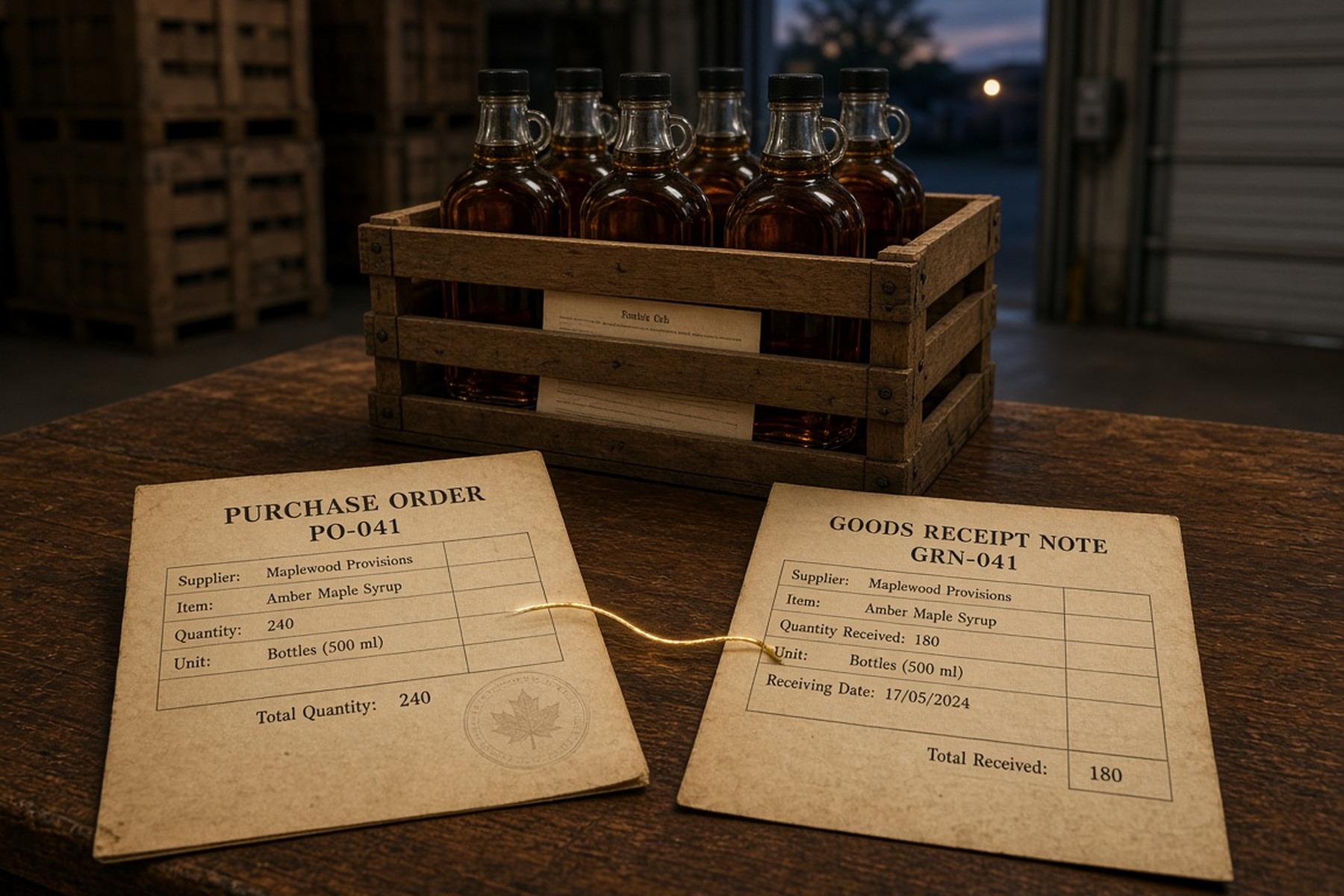
Every receiving desk has a version of this file.
Harborline ordered 240 units of amber maple syrup on purchase order PO-041. The warehouse booked 180 on goods receipt GRN-041. Same product. Same receiving run. Sixty units short.
A total on a dashboard can flag that. It cannot take you to the meeting. The reviewer still has to ask: is this the right order, the right receipt, the right row — and does the policy require a hold before payment?
That is the job Dara is built for.
Ask in a sentence. See the path. Open the file and row. The investigator owns the conclusion.
Dara arranges the records and shows where to look. It does not certify the work.
A typical receiving scene
This is a receiving walkthrough on planted files — the shape of a case, not a customer’s books. The files are the ones a receiving team already lives in: purchase orders, goods receipts, invoices, suppliers, and a receiving policy.
Harborline is the buyer. Amber maple syrup is the line. The order says 240. The receipt says 180.
The policy is plain. Quantities that differ on the order and the receipt must be investigated before payment.
The interesting question is not whether software can notice a difference. The interesting question is whether an investigator can move from that sentence to a path, to a source row, to a working paper the reviewer can open.
Ask in a sentence
Jordan Hale, the investigator, does not start in a query language. She asks:
Do the quantities on the order and receipt differ?
Dara compares quantity on PO-041 (240) and GRN-041 (180). They differ.
That answer is a finding, not a verdict. It is written in the same language as the question. It names the two documents. It does not bury the investigator in a result grid and leave her to reconstruct the story.
A second question in the same scene is just as ordinary: is the receipt from a supplier that is not on the listed suppliers? In Harborline’s files, another receipt — GRN-088 — names Night Haul Logistics, which does not appear on the list. The policy holds that receipt too.
One walkthrough. Two receiving holds. Both reachable from a sentence.
See the path
A quantity mismatch is a relationship, not a cell.
On the case graph, the amber maple syrup receipt is linked to the amber maple syrup order: received. That is one hop. You can see it. You can pin it. You can check the policy against that path.
The pin is the investigator’s choice. Dara does not decide the claim. The investigator pins the path she will take to review.
When the walk is longer — an invoice on one supplier, a hub buyer, another order, another invoice — the same idea holds. You are not looking at a cluster. You are looking at a walk you can explain: this entity, this link, this file.
Open the file and row
The path is only as good as the source.
For GRN-041, the source is goods_receipts.csv, line 2. The id is GRN-041. The name is Amber maple syrup receipt. The quantity is 180. Anyone at the table can open the same row.
That is the difference from a chat that paraphrases your files, and from a dashboard that totals them.
A dashboard gives you a number. Useful. It is not a path you can open.
A chat gives you language. It does not know this CSV. Asked again, the wording may change. It cannot point to line 2.
Dara gives you a path you can take to the meeting. Choose a node. A line opens the file and the row.
Check the policy on that path
Harborline’s receiving policy is a document, not a slogan.
Clause 1: the goods receipt quantity must match the purchase order quantity for the same order. Quantities that differ must be investigated before payment.
On the pinned path — receipt received against order — Check policy does not replace the investigator. It places the clause next to the path. The working paper then carries a claim the reviewer can read: hold payment until the sixty-unit gap is explained.
The system arranges the evidence. The investigator still writes the conclusion.
Export a working paper, not a screenshot
Export writes the paper from the pin.
The paper holds the case question, the path, the pin, the source row, the policy claim, and how it was found — each distinct question once, in plain language, with who asked and when.
It is a suggestion for the reviewer, not a conclusion by the system. It is something you can print, save, or attach. It is not a chat log.
That is the output receiving, accounts payable, and internal audit actually file: a working paper that still has a human name on it.
What this is worth
Speed is the obvious benefit. The investigator did not rebuild the join in a spreadsheet. She asked the sentence, saw the path, opened the row.
Traceability is the lasting one. Six months later, the paper still names PO-041 and GRN-041, goods_receipts.csv line 2, and the policy clause that required the hold. The trail is the work.
Control is the one that matters in the room. Dara does not certify the receiving check. It does not pay the supplier. It does not close the case. Jordan Hale owns the conclusion. The reviewer can disagree. The source is still there.
That combination is rare.
ERP and warehouse systems store the rows. BI tools chart the exception. Generative tools talk about the exception. Dara keeps the exception attached to the path and the file, in a paper the investigator signs.
For receiving, that is the difference between “we saw a variance” and “we can show the order, the receipt, the policy, and the row.”
The sixty units still have to be explained
Dara will not tell Harborline why 180 arrived instead of 240. Short shipment, split receipt, keying error, or something that should never be paid — that is still the investigator’s work.
What the system does is make that work visible. Ask. Path. Source. Policy. Pin. Paper.
Traceable to the source.
If you run receiving, accounts payable, or internal audit, this is the scene we open in a live walkthrough. Bring the files you already export. We run it.
Summary
240 on the order. 180 on the receipt. A dashboard can flag that. It cannot take you to the meeting.
A short walkthrough of a typical receiving case in Dara — from a sentence, to a path, to the source row, to a working paper the investigator still owns.
Hashtags
#InternalAudit#Receiving#Procurement#AccountsPayable#AuditEvidence#WorkingPaper
Notes
- Headline: 240 on the order. 180 on the receipt.
- This is a receiving walkthrough on planted files — the shape of a case, not a customer’s books.