Dara · RAG vs graph
The Long Tuning Cycle of Enterprise RAG and AI Agents — and What Comes After
Retrieval plus a strong language model looks enough in a demo. Getting the business to depend on it takes months of iterative work.
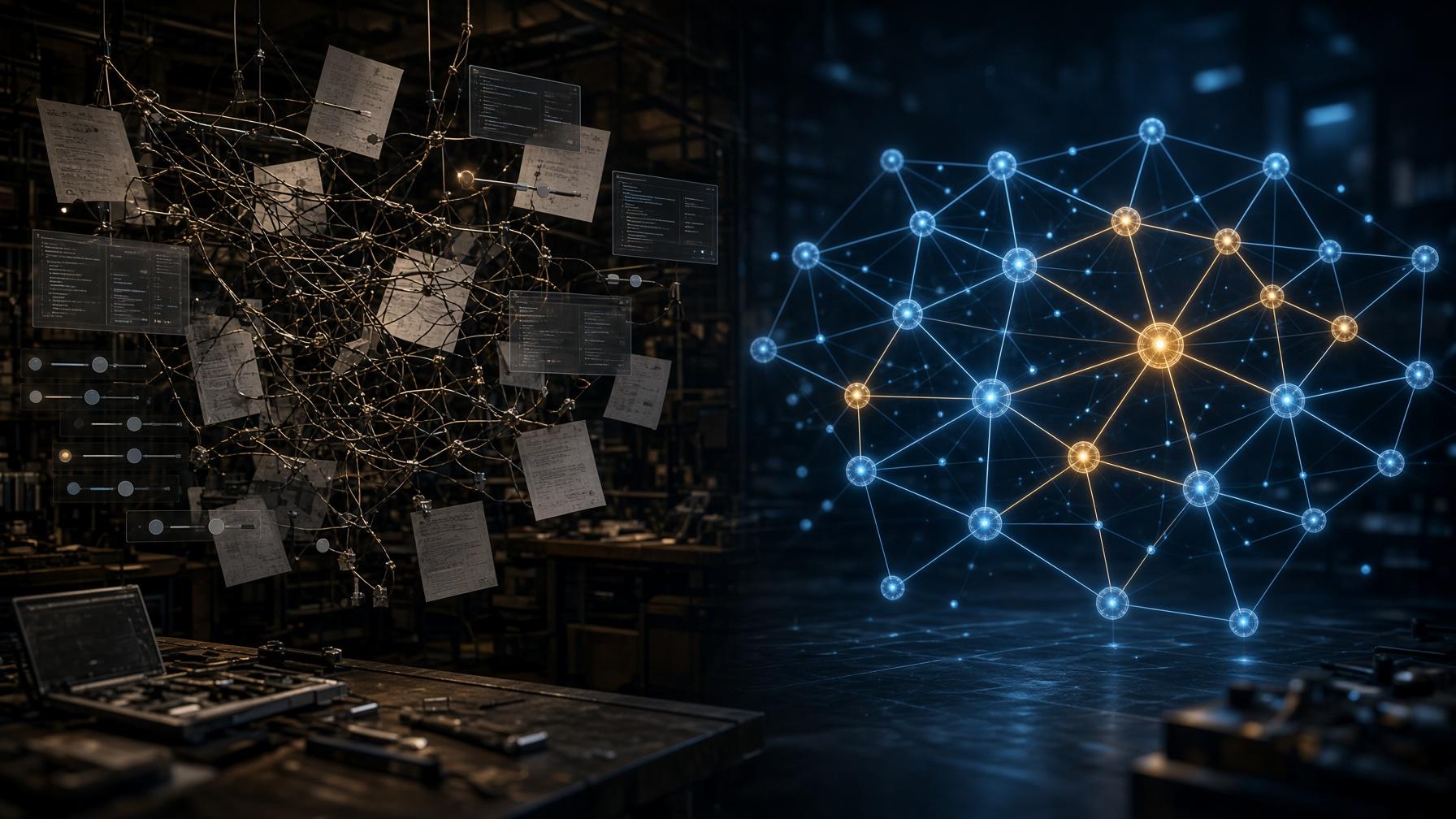
A significant amount of time goes into building and tuning enterprise RAG systems and AI agents. The reasonable expectation is that retrieval plus a strong language model would be enough to answer operational questions reliably. In practice, the path from a working prototype to something the business can actually depend on is much longer than expected.
This experience is not unique. Across industries, teams regularly report that moving RAG or agent systems from demo to production takes months of iterative work. The reasons are consistent.
Why demo to production takes months
Enterprise data is rarely clean or uniformly structured. Documents use different naming conventions, critical relationships are implicit rather than explicit, and the same entity may appear under multiple codes or descriptions. Chunking strategies, embedding models, metadata filters, and re-ranking logic all have to be adjusted repeatedly before retrieval quality stabilizes. Even then, the model may still ignore a retrieved constraint, confuse similar suppliers or batch numbers, or confidently fill a gap with a plausible but incorrect fact.
Agents add another layer. Each additional tool call or reasoning step increases the chance that an earlier misinterpretation will propagate. Because the intermediate trace is often incomplete, diagnosing why an answer went wrong becomes its own time-consuming task. Evaluation is equally difficult: most operational questions lack a ready-made golden dataset, so teams rely on slow expert review. Meanwhile, the underlying business data keeps changing — new suppliers, revised contracts, updated quality rules — so a configuration that worked last month begins to drift.
A mismatch the tuning cycle cannot close
These challenges are closely tied to the nature of large language models in the enterprise. Models trained on vast public corpora excel at generalization and handling ambiguity. They do not, however, possess reliable, up-to-date knowledge of a company’s specific processes, exceptions, or relationships. RAG tries to supply that knowledge at query time, and agents try to act on it, but both still depend on the model correctly interpreting and staying faithful to the retrieved context. Closing the gap requires continuous engineering: better retrieval, tighter prompts, additional guardrails, human review points, and monitoring. The tuning cycle becomes long because the system is compensating for a fundamental mismatch between what the model is good at and what the enterprise needs — specificity, consistency, and traceability.
Reduce how much the model has to infer
One way to shorten this cycle is to reduce how much the model is asked to infer or remember. This is the approach we took with Dara.
Instead of relying primarily on document retrieval and model interpretation to reconstruct relationships, Dara continuously records the actual relationships that occur in the business — orders, suppliers, material batches, quality events, shipments, documents, and the links between them — as an explicit graph. When a user asks a question in natural language, the system first traverses the relevant portion of the graph. The language model is used mainly to understand the intent of the question and to present the retrieved facts clearly.
This changes the tuning burden in several practical ways:
- Many lookups that previously required careful embedding tuning and prompt constraints become deterministic graph traversals. The same query returns the same connected records.
- Provenance is built in. Each node and edge can carry its source and timestamp, so it is immediately clear why a particular answer was produced.
- The model’s role is narrower, which reduces the surface area that needs constant prompt or guardrail adjustment.
- Updates are local. When a new quality result or shipment status arrives, only the affected part of the graph changes; there is no need to re-index large document sets or re-validate retrieval behavior across the board.
The result is not that tuning disappears, but that it shifts from “keep the model from hallucinating about our data” to “maintain the structure and coverage of the graph.” For many operational use cases — especially those involving traceability, root-cause analysis, or compliance — this has proven more predictable and easier to hand over.
The graph gives the model a stable foundation, so the answers stay anchored to what has actually happened in the business.
Large language models remain valuable for their flexible interface and ability to handle varied phrasing. The graph simply gives them that foundation, rather than leaving the answer to what the model finds statistically plausible.
If you run receiving, supply chain, or internal audit, this is the scene we open in a live walkthrough. Bring the files you already export. We run it.
Summary
Retrieval plus a strong language model looks enough in a demo. Across industries, the path from that demo to something the business can depend on takes months of iterative work.
The tuning cycle is long because the system is compensating for a mismatch: the model is good at ambiguity; the enterprise needs specificity, consistency, and traceability.
Hashtags
#RAG#AIAgents#KnowledgeGraph#EnterpriseAI#Traceability#SupplyChain#InternalAudit#Tuning
Notes
- Suggested title: The Long Tuning Cycle of Enterprise RAG and AI Agents — and What Comes After.
- This piece compares the RAG tuning cycle with Dara’s graph-backed answers. It does not characterize any retrieval product or any customer’s deployment.