Dara in grocery · Article 1 of 10
From the complaint to the batch to the supplier
A customer calls on Monday morning. They bought spinach mix at store 1847 on Sunday. They are unwell. Which lot was on that shelf — and can you still open the row?
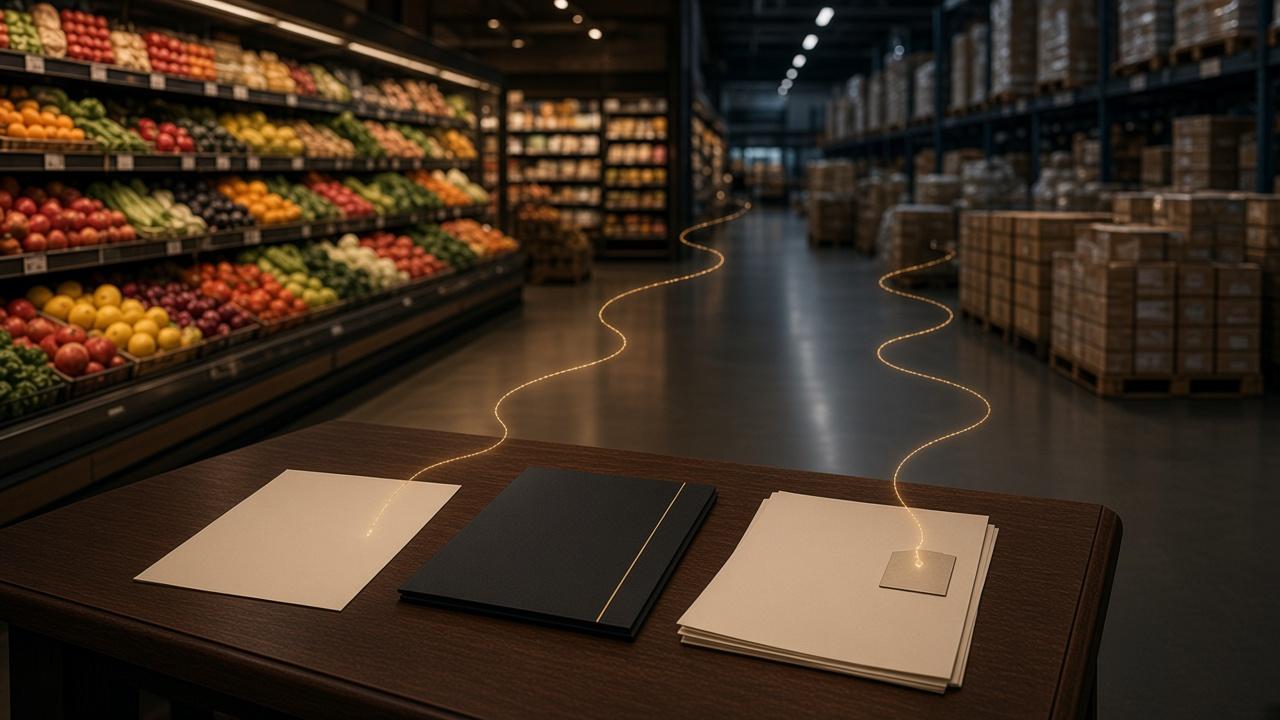
A customer calls on Monday morning. They bought a five-ounce bag of spinach mix at store 1847 on Sunday. They are unwell. The complaint names the product, the store, and a rough time of purchase.
Store operations can confirm the SKU. The distribution center can pull a receiving file. Quality has a certificate for the approved grower. Procurement has the vendor on the list.
None of that answers the question food safety, the DC, and the merchant will all ask within the hour: which lot was on that shelf, which receipt put it there, which supplier sits on that receipt — and can you still open those rows?
At this scale, a complaint is not a conversation. It is a clock.
The path that should already exist
A grocery chain already captures every piece of the traceback. The pieces rarely sit on one path.
- Consumer complaint in the quality or customer-care system
- POS or loyalty line for the store, the date, and the SKU
- Store perpetual inventory, or the production date on remaining bags
- DC shipment, ASN, and store delivery
- Goods receipt at the DC, with lot or batch
- Purchase order, contracted supplier, and the certificate in a vendor file or inbox
Hold-and-release assumes someone can move along that chain. In practice the chain is a set of exports. The lot was written on a receiving spreadsheet. The certificate was emailed in March. Sunday’s bags may be a later receipt than the one quality pulled from last week’s file.
When something goes wrong, the retailer does not lack process. It lacks a way to treat those facts as one record.
What the first two hours usually look like
Monday, 8:15 a.m. The complaint is in the queue. Food safety opens a ticket. The regional quality manager calls store 1847.
The store sends photographs of remaining bags. Two production codes are on the shelf. One is Thursday’s. One is Saturday’s. The customer’s receipt, if they still have it, is not attached yet.
Someone asks DC 12 for the inbound that supplied store 1847 over the weekend. DC quality is on the night shift; they will send the receiving workbook when they come in. Procurement forwards the approved-supplier pack for Harvest Greens. The legal name on the pack is Harvest Greens LLC. The bag says Harvest Greens. That is usually enough to close the first call.
It is not enough to isolate a lot. By late morning the team has a narrative: likely Harvest Greens, likely last week’s DC receipt, likely the Thursday code. They are still matching names across spreadsheets. They have not opened the Sunday receiving row. They have not confirmed that the supplier on that row is the company on the certificate.
The path, walked in full
Start at the complaint. Ticket C-1847-091. Store 1847. SKU 401188, five-ounce spinach mix, purchased Sunday afternoon. That is a row in the complaint file — not a summary in an email.
From the complaint to the store record. POS confirms the SKU rang at 14:22. Store inventory for that day still shows two active lots: B-188, received Thursday; and B-203, received Saturday. The remaining bags match both. The complaint does not yet name a code, so the path has to carry both lots until one of them can be dropped.
From the store lots to the DC. Both lots inbound from DC 12 on separate ASNs. Thursday’s store delivery traces to ASN-12-441. Saturday’s traces to ASN-12-458. Each ASN should land on a goods-receipt line at the DC, not on a weekly spinach-inbound total.
Here the path usually breaks. ASN-12-441, lot B-188, receipt GRN-12-0880. Supplier on that line: Harvest Greens LLC. Certificate on file for that legal entity, dated and in range. That path is clean enough to pin.
ASN-12-458, lot B-203, receipt GRN-12-0912. The product description is the same SKU. The supplier name on the receipt is Harvest Greens Produce. Close. Not the same. The Saturday inbound was a substitute load accepted on the dock after a short on the contracted purchase order. The receiving clerk used the name on the bill of lading. The purchase order still shows Harvest Greens LLC.
The certificate procurement forwarded at 8:40 a.m. belongs to Harvest Greens LLC. It does not belong to the Saturday receipt.
That is the whole investigation, if you can still open GRN-12-0912, line 14, in the receiving file, and the bill of lading that named Harvest Greens Produce. Without those rows, the team is left with two similar names, two lots, and a complaint that could attach to either.
The reviewer still has to decide what to do — hold B-203, hold both, call the substitute shipper, treat the complaint as isolated. That decision is not the path. The path is what makes the decision reviewable.
An approved-vendor list is not a traceback. A traceback is the receiving row for the lot that could have been on the shelf, and the supplier and certificate that belong to that row — not to a name that looks close.
What people do today
Export the complaint list. Export store inventory. Export DC receipts. Export the vendor master. Put them in a shared drive. Match lot numbers in Excel. Match supplier names by eye. Email the DC for the file that did not make the export. Wait for the person who knows that “HG Produce” is sometimes entered as Harvest Greens.
Similar names need a human call. A substitute load needs someone who was on the dock. A renamed co-packer needs a trip through last year’s vendor file. The certificate has to be fetched again, because the one in the pack is for the contracted name.
People can join these files. People can also join the wrong ones. Then review joins them a second time. Hours are normal. Overnight is not unusual. Time spent hunting the path is time taken away from the hold decision.
What the path and the source row allow
When complaint, lot, receipt, supplier, and certificate are one record — and each fact still points at its source file and row — the work changes shape.
You do not start by guessing which workbook to open. You start at the complaint and walk: complaint to SKU, SKU to the store lots in date, lots to the DC receipts, receipts to the supplier written on that line, supplier to the document that belongs to it.
Every link can go back to a source. Ticket C-1847-091 is a row. Lot B-203 is a row in the batch file. GRN-12-0912, line 14, is a row in receiving. Harvest Greens Produce is the name on that line, not a guess from the vendor master. The Saturday bill of lading is the document, not a screenshot of a summary.
The substitute load is no longer a story someone has to remember. It is a break in the path you can point at: purchase-order party on one row, receipt party on another. Review does not have to trust a verbal account, or pull the originals a second time after the meeting.
If a grower later names a batch, the same walk runs in reverse: which stores and tickets already sit on that batch, landing on rows rather than a memory of the weekend board.
What “we traced it” has to mean
In a grocery chain, “we traced it” is often a conference call. It needs to be a path a reviewer can follow after the shift has gone home. If any step is “we think” or “the DC will send it in the morning,” it is not yet evidence. It is a reconstruction.
The reviewer keeps the conclusion
Dara is built around that distinction. People, companies, contracts, batches, payments, and documents sit as one record, with the source file and row kept on each fact. You ask the business question. You see the path from the complaint to the batch to the supplier. You open the original.
Food safety, quality, the merchant, and internal audit still own the conclusion. The system does not decide whether this is a hold, a supplier conversation, or a closed ticket. A report summarizes. Evidence can still be opened. Dara shows the path and the source row. The reviewer keeps the conclusion.
If a short walkthrough would be useful, the door is open.
Summary
A customer is unwell. An approved-vendor list is not a traceback. A traceback is the receiving row for the lot that could have been on the shelf — and the supplier that belongs to that row.
Hashtags
#FoodSafety#Grocery#SupplyChain#Traceability#InternalAudit#QualityAssurance#RetailOperations#FSMA#Procurement#RiskManagement
Notes
- Suggested headline: From the complaint to the batch to the supplier
- This is a demonstration investigation: it shows how clues are found and how a working paper is formed. It does not characterize real parties.