Dara in hotels · Article 1 of 8
Why most hotel data never becomes evidence
When a guest gets sick, a health inspector is in the kitchen, or the night audit does not tie, the question is always the same. Can you show the path — not just the total?
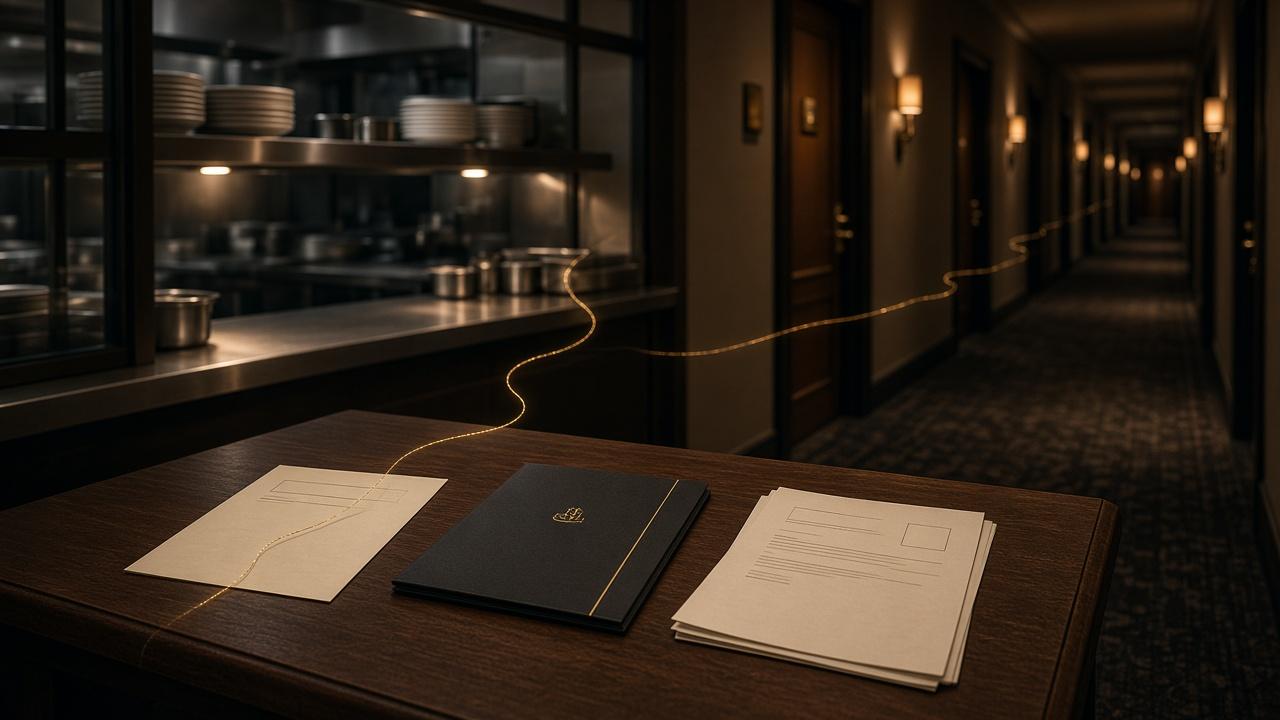
Most hotels can produce reports. Far fewer can produce evidence: a number that still opens the original file, the original row, the delivery note, the certificate.
That is not a reporting gap. It is a lineage gap. The property already captured the facts. It never kept the path between them.
Hotels are rich in systems and poor in lineage
A typical hotel already runs more records than any one person can hold in their head:
- PMS for occupancy, rates, and the guest folio
- POS for F&B checks, voids, and comps
- Purchasing and receiving for POs and goods receipts
- Inventory or cost control for theoretical versus actual
- Vendor files for contracts, insurance, and supplier certificates
- Spreadsheets that close the night audit when the systems do not agree
Each system is doing its job. The problem starts when a question has to cross them.
“Which supplier sent the shrimp on Saturday’s buffet?” is not a PMS question, and it is not only a POS question. It is a path: complaint or inspection → outlet → check or recipe → delivery or batch → PO → supplier → certificate.
If that path lives in five exports and a shared drive, the hotel has information. It does not yet have evidence.
Evidence is a path you can still open
A dashboard can tell you F&B cost is 34.2 percent. Evidence is being able to take the line that moved that number and land on the receiving row, the PO, and the invoice.
A night audit package can say the outlet closed. Evidence is tying a voided check, a store-room issue, and a guest folio adjustment to the same shift — with the source documents still attached.
Quality, procurement, internal audit, and the GM use different words for this. They all need the same thing: provenance. Who recorded this, in which file, on which row, and what sits one step upstream?
Without lineage, teams do not investigate. They reconstruct. They re-key, reconcile, and argue from memory — often the week the inspector or the auditor is already on property.
Mini-scenario: the inspector is already in the kitchen
A city health inspector asks for the receiving record and supplier certificate behind last night’s oyster service.
The F&B director knows the approved vendor. The steward has a delivery note in a folder. Purchasing has a certificate from last quarter in email. POS shows oysters were sold. The PMS has a guest folio if someone complained. None of these facts is wrong. None of them are joined.
By the time the lot, the certificate, and the folio sit in one place, the inspector has moved on — and so has the chance to treat the event as a controlled path instead of a scramble.
The hotel did not fail because it did not care. It failed because care was stored in silos.
Mini-scenario: cost leaked, and nobody can prove where
Month-end. F&B cost is two points over budget. Culinary blames receiving. Receiving blames the vendor. Purchasing points at a price change. Finance has a general-ledger total that does not match the cost-control export.
Each team can defend its number. What they cannot do quickly is walk from the GL total back to the PO lines that were short-received, the substitutions accepted on the dock, and the recipes that still assumed the old yield.
Until someone can open those rows, the meeting is a debate. It is not a finding. The leakage stays in the P&L; the evidence never quite arrives.
What unused hotel data actually costs
Siloed records create four quiet losses, even when every department is busy:
- Waste — over-delivery, short-delivery, and substitution hide in unmatched files
- Cost — leakage is explained in meetings instead of pinned to a document
- Risk — supplier, batch, and certificate are not on the same path when a complaint or recall arrives
- Guest satisfaction — recovery is slower and less consistent when the team cannot see what actually happened
The data was captured at the dock, at the POS, at the night desk. Capture is not the same as a record a reviewer can follow.
When the graph is the record
A source-traceable knowledge graph treats people, companies, contracts, batches, payments, and documents as one record — and keeps, on every fact, the exact source file and row.
You ask in plain language. You see the path. You open the original. The quality manager, the auditor, the outlet manager still owns the conclusion. The system does not decide. It makes the path visible enough that a conclusion can be reviewed.
That is the difference Dara is built around. A report summarizes. Evidence can still be opened. The graph is not a picture of the hotel. It is the hotel’s record, with lineage intact, sitting in the group’s own environment rather than in a shared cloud of someone else’s tenants.
Article 2 in this series will take the first path hotels are usually forced to walk under pressure: from a guest complaint or a health inspection to the exact delivery and the certificate behind it.
A practical next step
If this sounds like your property or group — strong systems, weak lineage — I am happy to share a short pilot outline. One complaint, one receiving mismatch, or one audit sample is enough to see what a source-backed path looks like in practice.
Summary
Most hotels can produce reports. Far fewer can produce evidence: a number that still opens the original file, the original row, the delivery note, the certificate.
Hashtags
#Hospitality#HotelOperations#InternalAudit#Traceability#NightAudit#Procurement#FoodAndBeverage#RiskManagement#GuestExperience#DataLineage
Notes
- Suggested headline: Why most hotel data never becomes evidence
- This is a demonstration investigation: it shows how clues are found and how a working paper is formed. It does not characterize real parties.